The Load, the Reach and the Routine: Fitting Kitchen Drawers to a Working Household
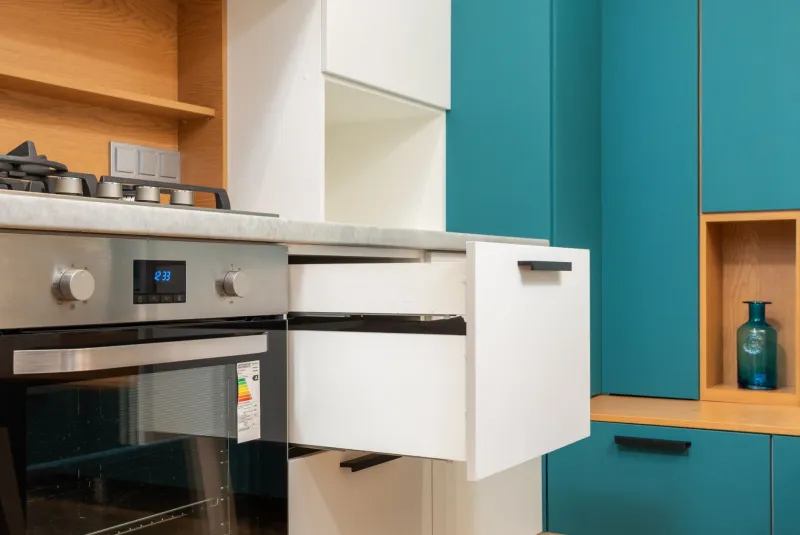
A kitchen is rarely judged on the day it is finished. It is judged on a wet Tuesday in February, when three pans are on the hob, the kettle has just clicked off, and someone is searching for the tin opener with one hand while holding a colander in the other. Fitted drawers either serve that moment or quietly obstruct it. At the bench, we have come to treat drawer planning as a form of observation: less a matter of selecting inserts from a catalogue than of recording how a household actually moves.
Begin with the hand, not the catalogue
The first measurement in a bespoke drawer is not a dimension but a habit. Who cooks, and how often? Which hand reaches first? Is the work centred on the hob, the sink or an island? In a household where one person cooks most evenings, the drawers should follow that person's route around the room. In a busier home, where children and guests pass through, the priority shifts towards clear labels, robust runners and a place for everything that is used daily. We ask clients to spend a week noting what they reach for before they decide what to store.
Heights that match what is carried
A familiar base unit stack — shallow at the top, medium in the middle, deep at the bottom — is a sensible default, but it is not a rule. The top drawer should be shallow enough to read at a glance and to hold cutlery without a second layer buried beneath the first. The middle drawer usually earns its place with utensils, cling film, foil and the smaller implements that accumulate in every kitchen. The bottom drawer should be sized to the largest pan, the stockpot or the slow cooker, and it should be strong enough to carry them without flexing.
Pan drawers deserve particular attention. A wide drawer running on full-extension runners rated for the load is a pleasure; the same drawer on modest slides will sag, stick and eventually fail. We specify runner capacity against the weight of the heaviest realistic load, not the average one. A drawer that holds a set of cast-iron pans is not over-engineered because it opens smoothly for a decade; it is simply sized honestly.
The opening, not just the box
Drawer planning is also a study of clearance. A deep drawer that pulls out across a walkway can be more obstructive than a cupboard door. Before fixing a layout, we check the sweep of appliance doors, the swing of the oven, the position of the dishwasher and the route between the sink and the hob. In smaller British kitchens, where the galley is narrow and the fridge door opens into the same space as the bin, a shallow drawer that opens without blocking the route is worth more than a cavernous one that must be negotiated.
The same logic applies at corners. A drawer unit in a corner can be useful, but only if the drawer front clears the adjacent run and the handle does not catch. Sometimes the better answer is a narrower drawer beside the corner and a carousel or pull-out within it.
Dividers that divide usefully
Internal dividers are often sold as the mark of a considered kitchen. They are useful when they follow the contents, and irritating when they do not. A cutlery insert should be sized to the actual cutlery, with enough depth for serving spoons and a knife block if one is used. A utensil drawer benefits from a few movable dividers rather than a rigid grid, because the contents of a kitchen change. For oils and condiments, a shallow drawer near the hob can work well, but it must be far enough from direct heat and easy to wipe out.
We prefer dividers that can be lifted, adjusted or removed. A drawer that cannot be reordered will eventually be used badly. The same applies to peg systems and tray inserts: they should be a help to the household, not a puzzle to be solved every time the drawer is opened.
Waste and recycling: the drawer that leaves the room
Recycling and waste storage is where fitted kitchen design most often meets local practice. Collection rules differ from council to council, and the number of bins in a British kitchen can be surprising. A pull-out bin unit is convenient, but it needs to be positioned where it can be opened with a full bag, away from the main cooking zone, and ventilated enough to avoid odours. If the plumbing beneath the sink is complicated, a separate drawer or a slim pull-out beside it may be the better solution.
We plan waste storage around capacity and emptying, not just appearance. A bin that is difficult to remove will be emptied less often; a recycling drawer that is too shallow will overflow. The drawer should earn its keep by making the weekly routine easier, not by hiding the problem.
A short survey of habit
Before specifying a run of drawers, we ask clients to carry out a simple exercise. Empty the current kitchen drawers onto a table. Sort the contents into three groups: used daily, used weekly, used occasionally. Measure the largest item and weigh the heaviest pan. Note which items are stored far from where they are used. This usually reveals that the existing kitchen has too many shallow drawers and too few deep ones, or that the cutlery is stored beside the sink when it is used beside the hob.
For trade clients, the same survey can be condensed into a schedule. A developer fitting a rental property needs robust, neutral storage that suits a range of tenants. A designer working with a keen cook may specify a deeper pan drawer and a dedicated spice drawer. The principle is the same: the drawer follows the routine, not the other way round.
Restraint at the bench
Not every gap needs a drawer. In older British homes, where walls are rarely square and floors have settled, a fixed shelf or a simple cupboard can be the more honest choice. Fitted drawers work best when the carcass is set out accurately, the runners are accessible for adjustment, and the drawer boxes are made to carry their load without relying on the front for strength. We build drawer boxes from solid timber and ply, with dovetailed or pinned joints where appropriate, and we leave enough clearance for seasonal movement.
The finished drawer should not draw attention to itself. It should open with one hand, close without a slam, and still run true after years of Sunday roasts and hurried breakfasts. That is the quiet test of fitted kitchen storage: not how many inserts it contains, but how little thought it demands when the room is busy.