Wobbly Hinges and False Economies: Rethinking the True Cost of Mass-Produced Furniture
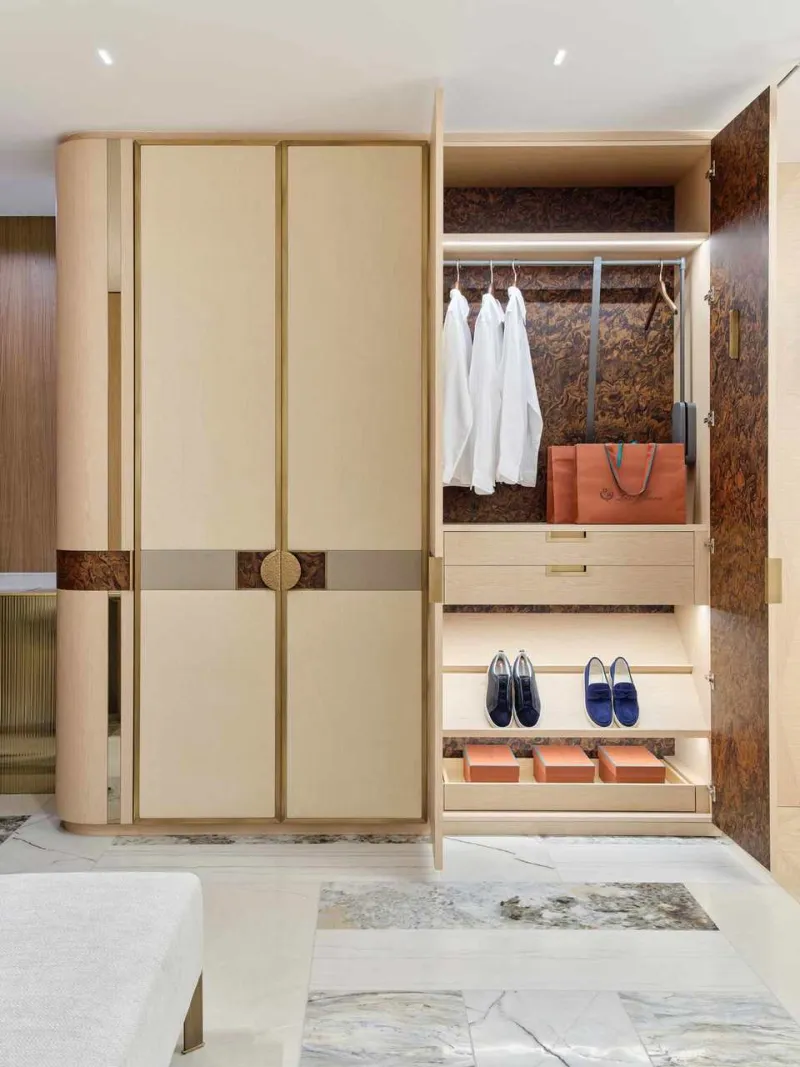
Photo: Faura Ltd, CC BY-SA 4.0, via Wikimedia Commons
Every few weeks, something arrives at the workshop that tells a familiar story in a slightly different accent: a wardrobe with a bowed back panel, a chest whose drawer runners have worn through, a shelf that has sagged beneath a modest collection of paperbacks. The owner is rarely angry. More often they are resigned, and faintly embarrassed to be asking whether a piece bought six or seven years ago is worth repairing at all.
That question — is it worth repairing? — sits at the heart of a quiet shift we have noticed among UK homeowners. People are beginning to do the arithmetic properly, and the numbers are not flattering to the flat-pack aisle.
The repair that starts the argument
A recent job involved a large sliding-door wardrobe in a 1930s semi in Hampshire. It had been purchased in 2019, assembled over a weekend, and had performed adequately until the doors began to catch. On inspection, the cause was straightforward: the particleboard carcass had absorbed moisture from a cold external wall and swollen along its base, pushing the track out of alignment. The hardware was sound. The material was not.
There is no economical remedy for swollen chipboard. We could replace the base panel, but the fix would cost more than the original unit, and the same failure would recur within a few years. The client ultimately commissioned a fitted wardrobe in birch ply and solid oak, scribed tight to the uneven wall and ventilated at the back. It will not swell, because the construction allows the wall to breathe and the material to move as timber should.
One repair, in isolation, proves nothing. But we see the pattern repeatedly, and patterns are what matter.
What "fitted" actually means
Much of the furniture sold as fitted is not fitted at all; it is simply large. It arrives in standard widths and depths and is coaxed into a space with filler panels and a certain amount of optimism. In a Georgian terrace or a 1930s semi — the two most common domestic building types in this country — almost no wall is straight, no corner is square, and no alcove is a standard size.
The consequence is predictable. Gaps are bridged with trim that never quite sits flush. Doors rub where the carcass is out of true. Skirting boards are cut away because there is no other option, and the join between furniture and wall becomes a permanent trap for dust and draughts. None of this is catastrophic. It is simply the accumulated friction of a product designed for an average room that does not exist.
Bespoke joinery inverts the process. The room dictates the dimensions, not the other way round. Scribing, chamfering and setting out on site are not luxuries; they are the difference between a piece that belongs in a house and one that merely occupies it.
The arithmetic of replacement
Advocates of mass-produced furniture point, reasonably, to price. A flat-pack wardrobe may cost a few hundred pounds; a fitted one will cost several times that. The comparison is fair as far as it goes, but it stops short of the full calculation.
Consider a notional twenty-year horizon. A cheap carcass may be replaced twice, possibly three times, in that period. Each replacement carries its own costs: delivery, assembly, disposal, the time taken, and — increasingly — the fee charged by a local authority for bulky waste collection. Add the cost of the failed piece itself, and the gap narrows considerably. Add the fact that a well-made piece can usually be adjusted, re-hung, re-finished or extended into a new house, and the gap frequently closes altogether.
We are careful not to overstate this. Bespoke joinery is not the right answer for every room or every budget, and there are situations — a short tenancy, a temporary arrangement — where a modest off-the-shelf item is entirely sensible. The argument is not that cheap furniture is indefensible. It is that cheap furniture is rarely as cheap as it appears.
Waste, and the quiet cost of it
There is an environmental dimension that rarely surfaces in the showroom conversation. Particleboard and MDF are not inherently villainous materials; both have legitimate uses. But furniture built from them is difficult to repair and almost impossible to disassemble, which means it tends to travel in one direction: from bedroom to skip.
By contrast, a traditionally jointed piece is designed to come apart. A mortise-and-tenon frame can be knocked down, its joints cleaned and re-glued, its components replaced individually. We have re-solemnised chairs made in the 1890s whose frames were sound because someone, a century ago, chose a joint over a staple.
This is not nostalgia. It is a practical observation about how objects age, and about what happens to a household's carbon footprint when furniture is treated as durable rather than disposable.
Where bespoke earns its keep
The strongest case for fitted joinery is not philosophical but spatial: awkward alcoves, chimney breasts, under-stair voids, sloping ceilings in loft conversions, and rooms where every centimetre counts. In these places, a made-to-measure piece often creates storage that no standard unit could provide, and the difference is not marginal — it can be the equivalent of a small extra room.
It is also worth noting that bespoke work is not always bespoke-priced. A simple painted alcove unit in a mid-range hardwood, with a sensible specification and no unnecessary flourishes, can sit surprisingly close to the cost of a good-quality branded flat-pack system once the latter is properly fitted and its internals upgraded.
A final consideration
Furniture is one of the few purchases a household makes that is expected to be lived with, touched and loaded daily for decades. Judged on that basis, the relevant question is not what a piece costs on the day it is bought, but what it costs across the whole of its life. On that measure, the workshop still has a good deal to say — and increasingly, UK homeowners appear willing to listen.